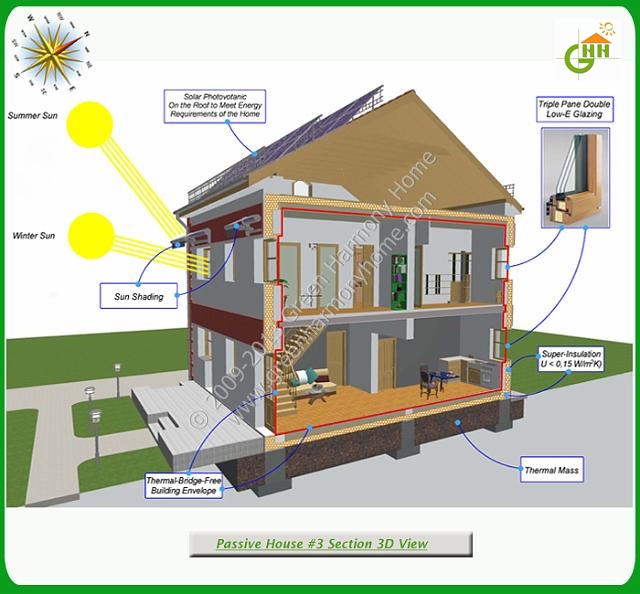
There are a few key elements of this super insulating passive house:
- The thermal heat loss coefficients
(U-Values) of external walls, slabs to the ground, and roof
are within 0.1 to 0.15 W/(m²K) (for Central European climate).
- Construction Reducing Thermal Bridging – Heat will
flow through the path of least resistance such as wood, metal or certain
foundation materials. Therefore it is important to not only have high
insulation values, but to eliminate thermal bridges from the inside of
the home to the exterior that are common in typical construction. Avoiding thermal bridges is fulfilled throughout the thermal envelope.
- Airtight Construction – Building an airtight
thermal envelope is important for energy savings, humidity control and
ensuring the longevity of the building structure.
Highly Efficient Passive House Windows and Doors
Windows and doors in a Passive House must be extremely efficient as well to
complement the super insulation. We use triple pane windows with low-e
coatings and Argon gas to reach this goal. Below are the three main requirements of
windows for a Passive House according to the Passive House Standard:
- Triple glazing with two low-e coatings
- “Warm Edge” spacers between the panes of glass
- Super-insulated frames
The thermal loss coefficients Uw of Passive House windows
are lower than 0.8 W/(m²K) according to the new European standard
(EN 10077).
Mechanical Ventilation with Heat Recovery
Proper ventilation of a Passive House is critical especially due to
the air tightness in the home that does not exchange the stale air with
fresh outdoor air very much at all. Opening the windows is not a
convenient strategy, nor one that can be performed year round. For these
reasons a mechanical ventilation system in the form of an HRV or ERV is
used to exchange stale air from the most polluted rooms (kitchen, bath,
utility) and fresh air is vented into the living quarters (living room
& bedrooms).
A Heat Recovery Ventilator (HRV) or Energy Recover Ventilator (ERV)
is used in order to recover 75% to 95% of the heat by passing the warm
exhaust air past the incoming cold air in a method that does not mix the
two streams in order to make sure only fresh air is being vented into
the home and no air is being recirculated.
Innovative and Efficient Heating Technology
The heating requirement is so low in a Passive Home due to all of the
other factors that usually the home can be heated by simply heating the
fresh air that is being brought into the home via the mechanical
ventilation system. Various methods can be used to heat the incoming air
inline which eliminates the need for additional ducting in the home.
Some of the common methods to heat the air in a Passive House include
the following:
- Small heating pump
- Small condensing gas burner
- Compact unit for all in one heating, ventilation and domestic hot water
- Renewable Sources of Energy